Is your hairline receding, or has it just grown up?
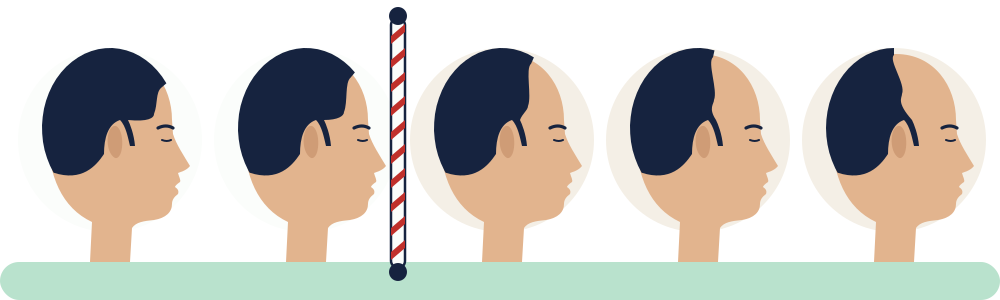
- Adolescentlow and rounded
- Maturelifted once, then still
- Early Mthe corners move
- Deeperthe temples keep going
- Further backa clear M
Templeline is about one stretch of scalp: the front edge, and the temples above it. How to tell a mature hairline from a receding one, what the drug labels really say about the corners, haircuts that work with it, and hairline surgery without the sales pitch.
1 The part most sites leave out
The temples are where the drug labels are quietest
Both medicines labelled for male pattern hair loss were measured mostly on the top of the head. Their own labels say so, and we quote them rather than round them up.
Where the evidence was measured
Seen from above, front of the head at the top. Drawn from the label quotations on our receding hairline guide.
- 1 · Hairline and templesFinasteride:
Efficacy in bitemporal recession has not been established.
Minoxidil 5%:not intended for frontal baldness or receding hairline
. - 2 · Top of the head, front halfWhere the finasteride trials counted hair: the anterior mid-scalp, which did not include the area of bitemporal recession or the anterior hairline.
- 3 · Crown (vertex)Where the 5% minoxidil label says the product is for: the top of the scalp, vertex only.
2 Every route, and who it pays
From the barber’s chair to the surgeon’s
A receding hairline has four kinds of answer: wear it well, treat it with a prescriber, move hair surgically, or disguise it. Most of the useful first steps pay us nothing, and we say which ones do.
5 routes pay us nothing; 3 carry a marked link
Grouped straight from the options table on our receding hairline guide.
3 The guides
One question per guide, answered first
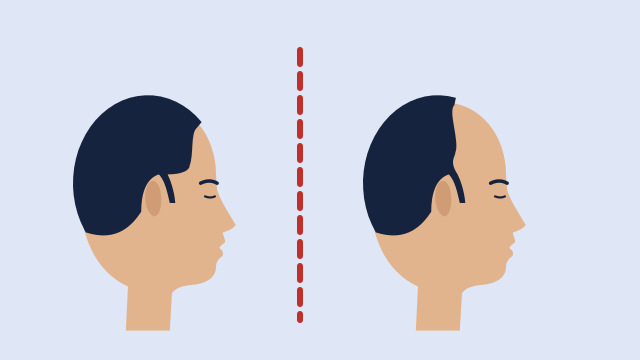
Mature vs Receding Hairline: How to Tell Them Apart
A mature hairline moves once and stops; a receding one keeps going. Three checks you can run yourself, and why a ruler measurement is not one of them.

Early Signs of a Receding Hairline, Up Close
The first signs are small: softer corners, finer hairs at the edge, a fringe that sits differently. What they look like, what else mimics them, and what to do next.
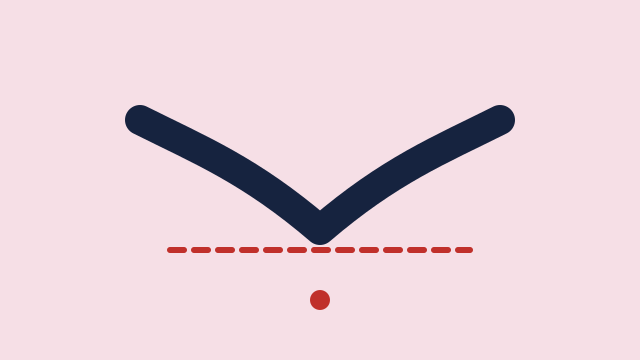
Widow's Peak vs Receding Hairline: Trait or Recession?
A widow's peak is a shape you were born with; a receding hairline is a line that moves. How to tell which you have, and why recession can make a peak look sharper.

A Receding Hairline in Your Twenties (or Teens)
Early recession is common and not always the start of something big. What is normal at eighteen or twenty-five, what to rule out, and why it pays to be slow about surgery.

Can a Receding Hairline Grow Back? What the Labels Say
Sometimes a little, often not at the temples, and never where follicles have scarred. What regrowth depends on, and what the drug labels actually measured.

How to Slow a Receding Hairline: What Has Evidence
Diagnosis first, then an honest look at the two labelled medicines and what they say about the temples. The order to do things in, and what to ignore.
4 How we work
How Templeline works
Templeline covers the receding hairline and nothing else, which lets every page go further than a general hair-loss site can. We read the primary sources, the drug labels on DailyMed, MedlinePlus, the American Academy of Dermatology, the NHS and peer-reviewed surgical reviews, and quote them rather than paraphrase them into something more hopeful.
Three rules shape what you will read here. First, a fact without a source does not go on the page; that is why you will not find a "mature hairline sits one finger above your crease" rule here, because we could not trace one to anything better than a clinic blog. Second, no page gives dosing instructions, shows before-and-after photos, ranks clinics or quotes patients. Third, every page that mentions a paid route also names one that pays us nothing, usually a GP or dermatologist, a barber, or a local pharmacy.
Nobody medical has reviewed this site. It is information, written carefully, and it is not a substitute for a clinician who can look at your scalp.