The receding hairline, read honestly
A receding hairline is hair loss that starts at the temples and moves back into an M. Here is how to tell it from a hairline that has simply matured, what the drug labels say about the temples (less than you would hope), and every route from the barber's chair to surgery.
Some links on this page pay us. They are marked paid link beside the words, and they sit next to at least one route that pays us nothing. What we earn and what we refused: how Templeline earns.
On this page
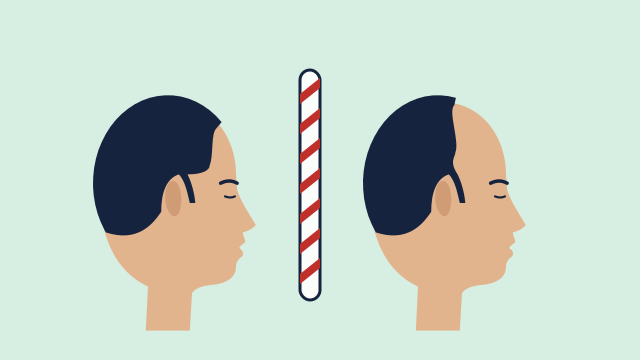
A receding hairline is the front edge of your hair moving back, usually fastest at the temples, until the line takes on an M shape. In men it is most often the first visible sign of hereditary hair loss, but not every higher hairline is receding, and not every receding one is the hereditary kind. This page walks the whole question in order: what you are looking at, whether it is moving, what can be done about it, and how to wear it well in the meantime.
What a receding hairline actually is
A receding hairline is usually the opening move of androgenetic alopecia, the hereditary pattern of hair loss. MedlinePlus Genetics describes the male pattern as loss that begins "above both temples", after which the hairline moves back to form a characteristic "M" shape, often with thinning at the crown as well. The American Academy of Dermatology puts it the same way from the other end: when a man has hereditary hair loss, the first sign is often a receding hairline or a bald spot at the top of the head.
The mechanism matters because it explains why the temples behave differently from the rest of your head. Follicles in the pattern area are sensitive to dihydrotestosterone (DHT), a hormone made from testosterone. Under its influence each growth cycle gets shorter, and the hairs those follicles produce get finer and shorter too. DermNet calls this miniaturisation: the hair does not fall out all at once, it thins out and fades back. Hair at the back and sides of the head is far less sensitive, which is why a fringe of hair around the sides usually stays.
It can begin early. MedlinePlus Genetics notes that androgenetic alopecia "can start as early as a person's teens", and that more than 50 percent of men over age 50 have some degree of hair loss. So a higher hairline at twenty-two is not unusual, and it is not automatically the start of something bigger either.
Receding or maturing: the test is time
The honest answer is that you cannot tell from one look in the mirror. Almost everyone's hairline changes after the teenage years: the low, rounded line most boys have moves up a little and the corners at the temples sharpen. That is usually called a mature hairline. The difference between maturing and receding is not where the line sits on one day, it is whether it keeps moving.
The same photo, every three months
Hair pushed back, same light, same angle. What you are looking for is movement, not position.
Matured and stopped · the corners hold still between photos
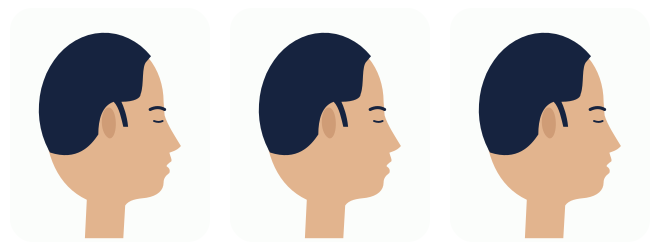
- Photo 1
- +3 months
- +6 months
Still receding · the temples deepen photo after photo
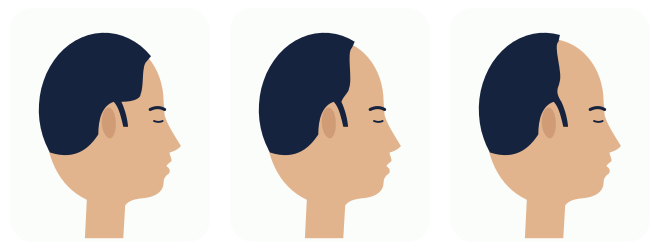
- Photo 1
- +3 months
- +6 months
Signs that point toward a line that has matured and stopped:
- The shape changed once, then held still across a year or more of photos.
- The hairs right at the front are as thick and as long as the hair behind them.
- The corners are slightly higher than they were, but even on both sides.
Signs that point toward a receding hairline:
- The temples keep deepening, photo after photo, into a clear M.
- The hairs at the front edge look finer, shorter or wispier than the hair behind them.
- There is thinning at the crown as well, or hereditary hair loss in close family.
We will not give you a measurement to check against. You will find confident ones online, a finger's width above the top forehead crease or a few centimetres, but every version we traced came from a clinic or product blog, and they do not agree with each other. Photographs are a better instrument: same light, same angle, hair pushed back, every three months. Our full guide to telling a mature hairline from a receding one sets out how to take them, and the early signs of a receding hairline covers what to look for close up.
Signs it may not be ordinary recession
Some hair loss at the front of the scalp is not hereditary, and a few kinds need a doctor quickly because they can scar the follicle for good. These are the signs to take to a GP or dermatologist rather than a barber or a website:
- Eyebrow loss, or loss along the sides as well as the front. Frontal fibrosing alopecia "often looks like a receding hairline", according to the AAD, and it destroys follicles, causing permanent loss. Most people diagnosed are women, but men have been diagnosed with it too.
- Redness, itching, bumps, pain or scaling at the hairline. Pattern hair loss is usually quiet. An inflamed scalp is a reason to be examined.
- Tight styles, tender roots or "tenting". The AAD says the hairline is one of the first places traction alopecia shows, and continued pulling can make the loss permanent.
- Loss that is sudden or patchy. The Drug Facts label on a 5% minoxidil solution tells you not to use it if your hair loss is sudden and/or patchy, or if you do not know the reason for your hair loss. That is the label telling you to get a diagnosis first.
Caught early, frontal fibrosing alopecia can often be stopped, which is exactly why these signs belong at the top of this page and not at the bottom. The NHS makes the same point more generally: see a GP about what is causing your hair loss before thinking about a commercial hair clinic.
The temples are where the evidence is thinnest
This is the part most hair-loss marketing leaves out. The two medicines sold in the US with labelling for male pattern hair loss were studied mostly on the top and crown of the head, and their own labels are careful about the hairline.
Where the evidence was measured
Seen from above, front of the head at the top. Drawn from the label quotations in this section.
- 1 · Hairline and templesFinasteride:
Efficacy in bitemporal recession has not been established.
Minoxidil 5%:not intended for frontal baldness or receding hairline
. - 2 · Top of the head, front halfWhere the finasteride trials counted hair: the anterior mid-scalp, which did not include the area of bitemporal recession or the anterior hairline.
- 3 · Crown (vertex)Where the 5% minoxidil label says the product is for: the top of the scalp, vertex only.
- The US Propecia (finasteride) label states: "Efficacy in bitemporal recession has not been established." In the trials, hair counts "were obtained in the anterior mid-scalp area, and did not include the area of bitemporal recession or the anterior hairline."
- A store-brand 5% minoxidil solution's Drug Facts say it is for regrowing hair "on the top of the scalp (vertex only…)" and that it "is not intended for frontal baldness or receding hairline".
- MedlinePlus, in its consumer page on topical minoxidil, goes further: "Minoxidil has no effect on receding hairlines."
None of that means a doctor will never prescribe for a receding hairline. MedlinePlus's own finasteride page describes the condition it treats as thinning "leading to a receding hairline or balding on the top of the head in men", and the AAD says treatment for hereditary loss can help stop or slow it and may help regrow hair. What it does mean is that the temples were not where the regrowth was measured, so any promise of a restored hairline from a pill, lotion or subscription is running ahead of the label. Holding what you have is the realistic goal; getting the corners back is not something the labels support. Our guide to how to slow a receding hairline goes through what does have evidence, and whether a receding hairline can grow back answers the regrowth question on its own.
Your options, side by side
There are four kinds of response to a receding hairline: do nothing and wear it well, treat it with a prescriber, move hair surgically, or disguise it cosmetically. Most people end up combining two. The table is a map, not a ranking; the right order depends on your age, how fast the line is moving and what you want.
5 routes pay us nothing; 3 carry a marked link
Grouped straight from the options table on our receding hairline guide.
| Option | What it does at the temples | What the source says | Who decides | Pays Templeline? |
|---|---|---|---|---|
| Watch and photograph | Nothing; it tells you whether anything else is needed | Pattern loss is judged by change over time, not one look | You | No |
| A shorter haircut | Hides the contrast; changes nothing medically | Cosmetic only | You and a barber | No |
| GP or dermatologist visit | Diagnosis first; rules out scarring and traction loss | The NHS says see a GP before a commercial clinic | A clinician | No |
| Finasteride (prescription) | May hold or slow loss; temple regrowth not shown | Label: efficacy in bitemporal recession not established | A prescriber | Only if you use a telehealth link we mark |
| Topical minoxidil | Studied for the crown | Label: not intended for frontal baldness or receding hairline | You, with the label and a pharmacist | No |
| Hairline transplant | Moves donor follicles to the front | StatPearls: needs a stable pattern and a conservative hairline | A surgeon | Only the HairClub consultation link |
| Hairline lowering surgery | Moves the whole scalp forward | Candidates need a stable hairline, which excludes most men | A surgeon | No |
| Fibres and concealers | Colours the gaps between existing hairs | Washes out; needs hair to cling to | You | Only the Toppik link |
Everything marked "No" in the last column is a route we recommend on its merits and earn nothing from. The cheapest meaningful step on the whole list, a proper look from a clinician, is one of them.
Talking to a prescriber, in person or online
The medical route starts with a person who can examine you and prescribe, and the most useful thing they do is not the prescription, it is the diagnosis. A GP or a board-certified dermatologist can tell pattern loss from frontal fibrosing alopecia, traction or shedding from illness, and that visit pays us nothing. The AAD recommends seeing a board-certified dermatologist when hair loss first starts, and says that for hereditary loss the earlier treatment starts, the better it works.
Finasteride is a prescription medicine. The label restricts it to men, lists depression and suicidal ideation and behaviour among the effects reported after it came to market, and MedlinePlus warns that anyone who is or may become pregnant should not touch broken or crushed tablets. The NHS notes that finasteride and minoxidil do not work for everyone and only work for as long as they are used. We do not describe doses or regimens anywhere on this site; that is a decision for the prescriber and the label, made with your history in front of them.
Online services are one way to reach a prescriber, not a treatment in themselves. Keeps says a licensed medical provider reviews each order and that plans can be paused or cancelled at any time; you can read its terms at Keepspaid link. Happy Head describes remote consultations with dermatologists and compounded prescription formulas, which you can look at on Happy Headpaid link. Before choosing any compounded topical, read the FDA's April 2025 alert: it says there is currently no FDA-approved topical formulation of finasteride, and that it has received adverse-event reports for compounded versions. Filling a prescription from your own doctor at a local pharmacy is equally valid and pays us nothing.
Surgery: moving hair, or moving the hairline
There are two operations aimed at the front of the scalp, and they suit different people. A hairline transplant moves individual follicular units from the back of the head, where hair is resistant to DHT, to the front. Hairline lowering, also called forehead reduction, removes a strip of forehead skin and brings the whole hair-bearing scalp forward.
For a receding hairline the transplant is the usual option, and the StatPearls review is clear on the conditions: ideal candidates have "a clear, stable pattern of hair loss", surgeons should design "a conservative, natural hairline", and the risks include "infection, scarring, graft failure, unnatural hairlines, and temporary shock loss". Donor hair is finite, so a hairline drawn too low in your twenties can leave you short of hair for the crown later. Our guide to a hairline transplant, from design to recovery covers it properly.
Hairline lowering is mostly not for men with pattern loss. A 2020 review says candidates "must have a stable frontal hairline (thus excluding most men)", and older and newer reviews describe the typical candidate as a woman with a naturally high hairline and no progressive hair loss. The comparison is in hairline lowering vs a hair transplant.
Who holds the instruments matters as much as the technique. The International Society of Hair Restoration Surgery warns about unlicensed technicians performing surgery, lists complications from scarring and unnatural hairlines to a depleted donor area and infections, and tells patients to ask who will make the incisions and harvest the grafts. If you want to talk it through in person in the US or Canada, HairClub offers a free consultation, which you can book through HairClubpaid link; a consultation with an independent surgeon you have checked on the ISHRS directory is the equivalent route that pays us nothing.
Cutting and styling around it
A good haircut does more for how a receding hairline looks than anything in a bottle, starts working the day you get it, and pays nobody but the barber. The principle is contrast. The eye reads recession from the gap between dark, dense hair and bare skin at the temples; shorter sides and a shorter top shrink that gap, while long hair combed forward over it draws attention to it.
Cuts that tend to work: a buzz cut or short crop, a crew cut, a textured crop with a slightly ragged fringe, or longer hair swept back with some texture. Cuts that tend not to: a heavy straight fringe covering a deep M, a hard parting that exposes one temple, or length on top grown to compensate. Our haircuts for a receding hairline page matches cuts to how far the line has moved, and there are separate guides to the buzz cut and to hairstyles for receding temples.
Concealers are the last cosmetic tool. Hair-building fibres such as Toppikpaid link are coloured keratin fibres that, in Toppik's own words, cling to your existing hair and stay until your next wash, so they fill thinning areas but cannot cover bare skin. A darker cut with a little texture often does the same job at no cost.
What we would do first
If you have just noticed your temples, this is the order that wastes the least money and closes off no options:
- Take dated photos now, hair pushed back, in the same light and at the same angle, and repeat every three months.
- Check the list of signs above. Any of them, and a GP or dermatologist comes first.
- Get a haircut that suits the hairline you have today.
- If the line is clearly moving and it bothers you, talk to a prescriber about whether treatment makes sense for you, knowing the labels do not promise the temples back.
- Leave surgery until the pattern is stable and a surgeon you have checked can show you a conservative design.