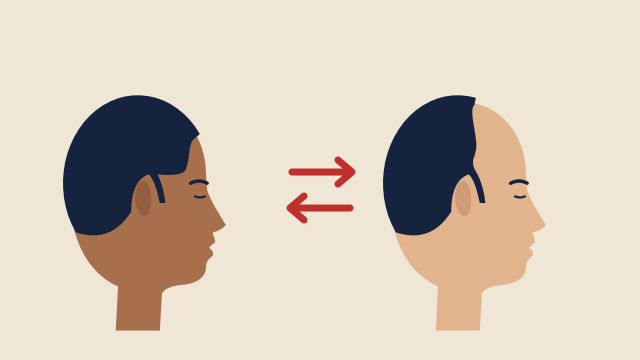
Hairline lowering and a hair transplant both bring a hairline further down the forehead, but they work in opposite ways and suit different people. Hairline lowering, also called forehead reduction, removes a band of forehead skin and pulls the existing hair-bearing scalp forward in one operation. A transplant leaves the scalp where it is and moves individual follicles to the front. The surgical literature is consistent on the key point: hairline lowering suits people with a naturally high hairline that is not moving, which excludes most men with a receding hairline. This guide explains why.
How hairline lowering works
Hairline lowering is a single operation that shortens the forehead. The surgeon removes a strip of skin along the front of the hairline and advances the scalp behind it, so the hair you already have ends up lower. A 2021 study of forehead reduction through a pretrichial incision, one made along the hairline itself, reviewed 641 cases, so this is an established operation rather than an experiment.
Because it moves existing scalp, the hairline is in its new position as soon as the operation is done. A 2020 review in the Facial Plastic Surgery Clinics of North America lists immediate results and "unsurpassed density" among its advantages over transplantation for lowering an overly high hairline.
The trade-off is the incision. The scar sits at the new hairline. On a hairline that stays where it is, that can be well hidden. On a hairline that later recedes, the scar is left exposed in front of it, which is the heart of why this operation and pattern hair loss do not mix.
How a hairline transplant works
A transplant harvests follicular units from the back of the scalp and implants them at the front, one graft at a time. The StatPearls review of the procedure explains that hair from the back of the head is resistant to androgens and keeps its characteristics after the move, which is what makes it useful for pattern loss.
Density builds from the grafts placed, rather than arriving all at once, and donor hair is limited. The review names the donor site as one of the primary limiting factors and lists infection, scarring, graft failure, unnatural hairlines and temporary shock loss as possible risks. Our full guide to a hairline transplant covers design and the questions to ask about who performs it.
Who each operation suits
This is where the literature is unusually clear, and it is the reason this comparison rarely ends in a close call for a man whose hairline is receding.
Two operations, two kinds of candidate
Drawn from the review quotations in this section.
Hairline lowering
- A stable frontal hairline, which excludes most men
- Typically women with a lifelong high hairline
- A mobile scalp
- No progressive hair loss in you or your family
Hairline transplant
- The standard surgical answer for pattern loss
- A clear, stable pattern of loss
- Adequate donor hair
- Donor hair is limited, whatever the technique
- The 2020 review says candidates for hairline lowering "must have a stable frontal hairline (thus excluding most men) and a fairly to very mobile scalp".
- A 2013 review describes it as "best suited for individuals, typically women, with a lifelong history of a high hairline and no familial or personal history of progressive hair loss".
- A 2026 review in the same journal says the best candidates "are usually women with stable frontal hairlines and mobile scalps".
A transplant, by contrast, is the standard surgical answer for pattern hair loss itself. StatPearls describes ideal candidates as having a clear, stable pattern of loss and adequate donor hair, and it notes that people correcting frontal baldness often achieve the most dramatic, lasting results.
So the short version: a high hairline you have always had, on a scalp that moves, may suit lowering. A hairline that has receded, or is still receding, points to a transplant or to non-surgical options.
The questions that decide it
A surgeon will assess this properly, but three questions narrow it down before you book anything.
- Has your hairline always been high, or has it moved? Old photos answer this. A lifelong high hairline is the classic lowering candidate; a receding one is not.
- Is there pattern hair loss in you or your family? The reviews above treat progressive or familial loss as a reason against lowering.
- How mobile is your scalp? Lowering depends on the scalp stretching forward; only an examination can judge this.
If your answers are "moved", "yes" and "not sure", lowering is very unlikely to be offered to you, and you should be wary of anyone who offers it without discussing the risk of future recession behind the scar.
Questions for a lowering consultation
If you are a candidate for hairline lowering, the consultation should answer a specific set of questions, and it is reasonable to ask for the answers in writing:
- How far can my hairline be lowered, given how mobile my scalp is?
- Where exactly will the incision run, and how will you shape it to follow a natural hairline?
- What happens to the scar if I later develop hair loss behind it?
- What changes in sensation should I expect, and for how long?
- Who performs each part of the operation, and what are their qualifications?
A surgeon who examines your scalp, explains the limits honestly and is comfortable with you taking time to decide is the one worth trusting. Pressure to book on the day is a reason to leave.
Can the two be combined?
You will see combined plans mentioned, lowering first and grafts later. We did not review the evidence on combining them, so we make no claim about it; whether any combination suits you is a surgeon's judgement after examining you. For a man with active pattern loss, the question of future recession behind the scar applies to any plan that includes lowering.
The risks, stated plainly
Both are real operations. For transplantation, StatPearls names infection, scarring, graft failure, unnatural hairlines and temporary shock loss, and the International Society of Hair Restoration Surgery warns about clinics where unlicensed technicians perform surgery. For hairline lowering, the scar along the hairline is inherent to the technique, and changes in sensation around the incision are a question to put directly to the surgeon; we did not find published complication rates at a standard we are willing to print, so we give none.
We also give no costs, recovery timelines or before-and-after images. Those vary with the person and the surgeon, and a consultation, ideally more than one, is where you should get them in writing.
Where to go from here
If your hairline is receding rather than naturally high, the decision is really about the options for a receding hairline, surgical and otherwise. Our guide to the receding hairline and what can be done about it covers them all, including what the medicine labels say about the temples. And if you are not sure whether your hairline has moved at all, go back to the start: mature versus receding hairlines explains how to find out.