Haircuts for a receding hairline, matched to how far it has moved
The best haircut for a receding hairline is usually shorter than the one you have, with the top kept textured rather than flat. Here is how to match the cut to your temples, what to say to the barber, and the cuts that make recession look deeper.
Some links on this page pay us. They are marked paid link beside the words, and they sit next to at least one route that pays us nothing. What we earn and what we refused: how Templeline earns.
On this page
The haircut that suits a receding hairline best is almost always the one that shrinks the contrast between your hair and the bare skin at your temples. That usually means shorter sides, a top with texture instead of a straight edge, and no attempt to pull length forward over the corners. A cut changes nothing about the hair loss itself, but it changes how the hairline reads from across a room, today, for the price of a haircut, and it pays us nothing to say so.
Why short usually wins
A receding hairline looks deeper when the edge is sharp. Dark, dense hair next to pale skin draws a hard line that the eye follows straight into the M. Take the hair shorter, and the colour difference between the hair and the scalp shrinks, so the corners soften without anything being hidden.
Same hairline, two haircuts
Both heads have the same receding temples. Only the length and direction of the hair differ.
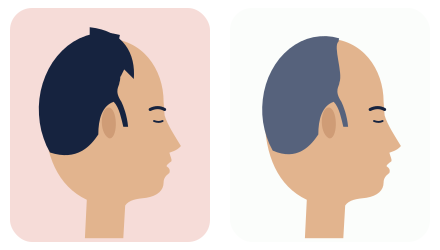
- Length pulled forwarda hard edge that leads to the corners
- Uniformly shortless contrast, so the M softens
The same logic works against long styles. Length on top can cover a hairline from the front, but it separates, blows back and parts at the temples, and every time it does the gap looks larger than it would under a short cut. There is also a practical cost: a style that depends on hair staying in one place needs product and fiddling every morning, and it is the first thing to fail in wind or rain.
That does not make long hair wrong. Plenty of people with receding temples wear it longer and wear it well, with the hair swept back from the face and some texture through it. The cut to avoid is the one engineered to cover the corners, because it announces exactly what it is covering.
Matching the cut to the hairline
The right cut depends on how far the temples have moved, and the figure below groups the four cuts that come up most often. Read your own hairline honestly, ideally from a photo with your hair pushed back, then look at the group that fits.
Four cuts, matched to the hairline
The same receding hairline under each cut. Pick the group that fits yours.
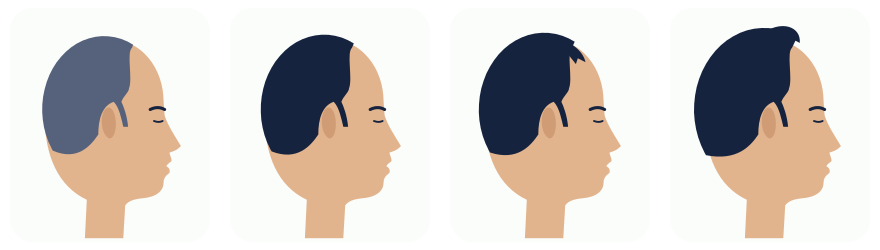
- Buzz cutdeep temples or a thin front
- Crew cuta clearly visible M
- Textured cropbarely moved to a visible M
- Swept backhair you want to keep long
Barely moved: a mature-looking line
If your corners have lifted a little but the front is still dense, you have the most freedom. A textured crop, a side part that is soft rather than razor-sharp, or longer hair swept back all work. The main thing to avoid is a heavy fringe cut straight across, which will look odd once the corners move and gives you nothing now.
Clearly moving: a visible M
Once the temples form a clear M, short and textured does the most work. A crew cut, which keeps a little more length at the front of the top and tapers it back, gives the front some weight without drawing a line. A textured crop does the same with a short, uneven fringe that breaks up the edge instead of drawing a straight one. Ask for the sides tight enough that they do not frame the temples.
Deep temples or a thin front
When the corners are deep or the front is thin, a buzz cut is often the most honest and the best-looking choice. Uniform short hair makes the hairline almost a non-event, because nothing is long enough to contrast. Our guide to the buzz cut with a receding hairline covers lengths, fades and the one situation where it backfires.
Hair you want to keep long
If you want length, wear it back. A swept-back style with texture, grown evenly and not parted hard over one temple, tends to look deliberate rather than defensive. Our guide to hairstyles for receding temples goes through longer styles and products in more detail.
What to say to the barber
A barber cannot give you what you want if you describe the style by name alone, because names mean different things in different shops. Say what you want the cut to do. These lines tend to get the right result:
- "I want the temples to look softer, not covered."
- "Keep the front textured, please, not a straight line."
- "Tight on the sides, so they don't frame the corners."
- "No hard part on the side where the hairline is higher."
Bring a photo of the style, and let the barber see your hairline pushed back before they start; good barbers look at the temples before they reach for the clippers. If the result draws a straight line across your forehead, say so next time. It is the most common mistake and the easiest to fix.
Cuts that make recession look deeper
The same few choices keep making receding hairlines look worse, and most come from trying to hide rather than trying to suit.
- A heavy straight fringe. It covers the middle and leaves the corners exposed at either end, turning a soft M into a sharp one.
- The comb-forward. Length grown on top and pulled over the temples separates the moment it moves.
- A hard side part over the higher temple. It draws a line straight to the thinnest point.
- Very short sides with long, flat hair on top. The contrast between the top and the sides makes the temple gap the focal point.
- Slick, wet-look products on a thin front. They clump hair together and show the scalp between the clumps.
Colour, texture and the cheap tricks
Beyond the cut, a few adjustments cost little and help. A matte product with some grip gives thin hair more body than a glossy one. Blow-drying the front up and back adds lift where the corners are. If your hair is very dark and your skin is light, the contrast is strongest, so shorter lengths help you more than they help someone with lighter hair.
Concealers are the step beyond that. Hair-building fibres such as Toppikpaid link are coloured keratin fibres that, as Toppik describes them, cling to your existing hair and stay until your next wash. They can thicken the look of a thinning front; they cannot cover bare skin at a temple that has already cleared. A shorter cut is usually a better first answer, and it pays us nothing.
When the cut is not enough
A haircut changes how a hairline looks, never how it behaves. If the line is clearly moving and it bothers you, the next conversation is with a clinician, not a barber, and the order matters: diagnosis first, then any decision about medicine or surgery. Our main guide to the receding hairline sets out every route, including what the drug labels actually say about the temples, and how to tell a mature hairline from a receding one will tell you whether you need to think about it at all.