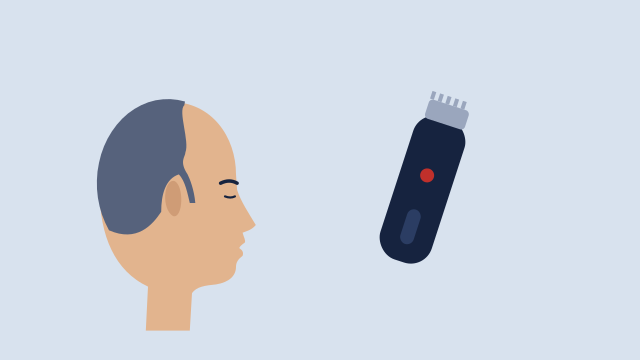
A buzz cut usually makes a receding hairline less noticeable, not more. When all the hair is uniformly short, there is no long, dark mass on top to contrast with the bare skin at the temples, so the M shape stops being the first thing people see. It works best on deeper recession and on people who are tired of styling around it. It works less well on a scalp with visible scarring or a very uneven hairline. This guide explains why, how to choose the length, and how to try it without regret.
Why a buzz cut works with recession
A receding hairline is noticeable mainly because of contrast. Longer hair on top creates a dense block of colour, and where it stops at the temples the skin shows as a sharp, bright shape. Cut everything short and the density on top drops towards the density of the thinning areas, so the edge softens and the line reads as a hairline rather than a gap.
The contrast is the thing you see
Same receding hairline. On the left, longer hair pulled forward; on the right, a uniform buzz.
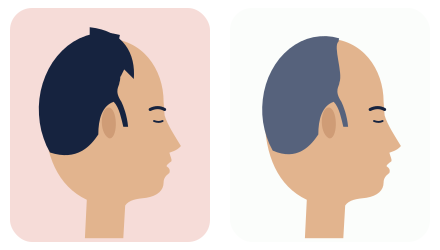
- Longer, forwarddense block, sharp edge
- Buzzedthe edge softens
There is a second benefit. A buzz cut ends the daily negotiation with a receding hairline: no deciding which way to push the fringe, no product, no checking in the wind. It looks the same at the end of the day as at the start, and it grows back if you do not like it.
Choosing the length
Length decides whether a buzz cut flatters a receding hairline or exposes it, and the right one is personal. Very short reveals the shape of your head and the colour of your scalp; slightly longer keeps a little shadow of hair everywhere, which blurs the hairline more.
We will not give you clipper-guard numbers: the same setting looks different on dark coarse hair and fair fine hair, and a barber looking at your head judges it better than a chart. The practical method is simpler: start longer than you think you want, look at it in daylight, then go shorter in a second pass if you would like. You cannot add hair back in the chair.
A few rules of thumb do hold across hair types:
- The darker your hair and the paler your skin, the more a slightly longer buzz helps, because contrast is highest for you.
- The deeper your temples, the more uniform the length should be; a longer top over deep corners brings the contrast back.
- If your hairline is thinning at the front rather than just receding, go shorter, since a longer buzz on thin hair can look patchy.
Fade or no fade?
A fade, where the sides are taken shorter than the top and blended, can suit a receding hairline or work against it. A gentle fade that keeps the top and sides close in length tends to work, because it tidies the outline without creating a new block of contrast. A dramatic high fade under a longer top can do the opposite, isolating a patch of hair on top and emphasising how far the corners have moved.
The rule that follows from the contrast logic: the more your temples have receded, the closer the top and sides should be in length. Ask your barber for a soft fade rather than a skin fade if you want one at all.
Shaping the front line
Barbers can tidy the hairline with a trimmer, and with a receding hairline the instinct is to square it off. Resist a hard, straight line-up drawn in front of your real hairline, because it looks drawn on and it grows out within days into a shadow. A natural outline, cleaned up but following your own hairline, ages far better.
If you have a widow's peak, a buzz cut makes it clearer. Whether that looks good is taste; our guide to a widow's peak versus a receding hairline explains why the peak often becomes more prominent as the temples recede.
When a buzz cut is the wrong call
Uniform short hair shows the scalp, which is mostly an advantage and occasionally a problem:
- Scars. A strip-harvest transplant leaves a line scar at the back of the head. The StatPearls review notes that the other main harvesting method, FUE, is often preferred for people who want shorter hairstyles because it avoids a linear donor scar. If you already have a strip scar, ask a barber how short you can go without showing it.
- Scalp conditions. Redness, scaling, bumps or sores along the hairline will be visible, and they are also reasons to see a doctor, because some conditions that start at the hairline, such as frontal fibrosing alopecia, can scar follicles permanently.
- A very uneven hairline. If one temple is much deeper than the other, a buzz shows the asymmetry. A slightly longer length is kinder.
Trying it without regret
If you are unsure, do it in stages. Ask for a short crop first, live with it for a week, then go to a buzz. Take a photo of your hairline before the cut, with your hair pushed back, as part of the photo record we recommend anyway. And give it two or three weeks before you judge it: a fresh buzz can look stark on day one and settle as it grows a little.
Upkeep is the one cost. A buzz cut looks its best when it is kept at the same length, which means either regular barber visits or clippers at home. Home clippers are cheap and pay us nothing to mention.
Keeping the shape between cuts
A buzz cut is simple, but it is not maintenance-free, and the details decide whether it keeps looking deliberate. The outline at the neck and around the ears grows untidy first, usually well before the top looks long, so a quick tidy of the edges does more than a full re-cut. If you cut it yourself, go over the head in several directions, because hair on the crown grows in a swirl and a single pass leaves patches. Check the result in daylight with a hand mirror, which shows the back and the temples better than the bathroom light does.
Two small habits help the hairline in particular. Keep the front the same length as the rest rather than leaving it a touch longer "for coverage", which only brings the contrast back. And protect a freshly buzzed scalp from the sun; a sunburnt scalp under very short hair is uncomfortable and draws the eye to the one area you want to look ordinary.
A buzz cut is not a treatment
A buzz cut changes how a receding hairline looks. It does not change whether it keeps receding, and cutting hair short does not affect the follicles. If your hairline is clearly moving and that bothers you, the next step is a conversation with a GP or dermatologist, and our guide to the receding hairline and every option for it sets out what the medicine labels do and do not say about the temples.
If you want something longer than a buzz, read hairstyles for receding temples next, and our haircut guide for a receding hairline matches cuts to how far the hairline has moved.